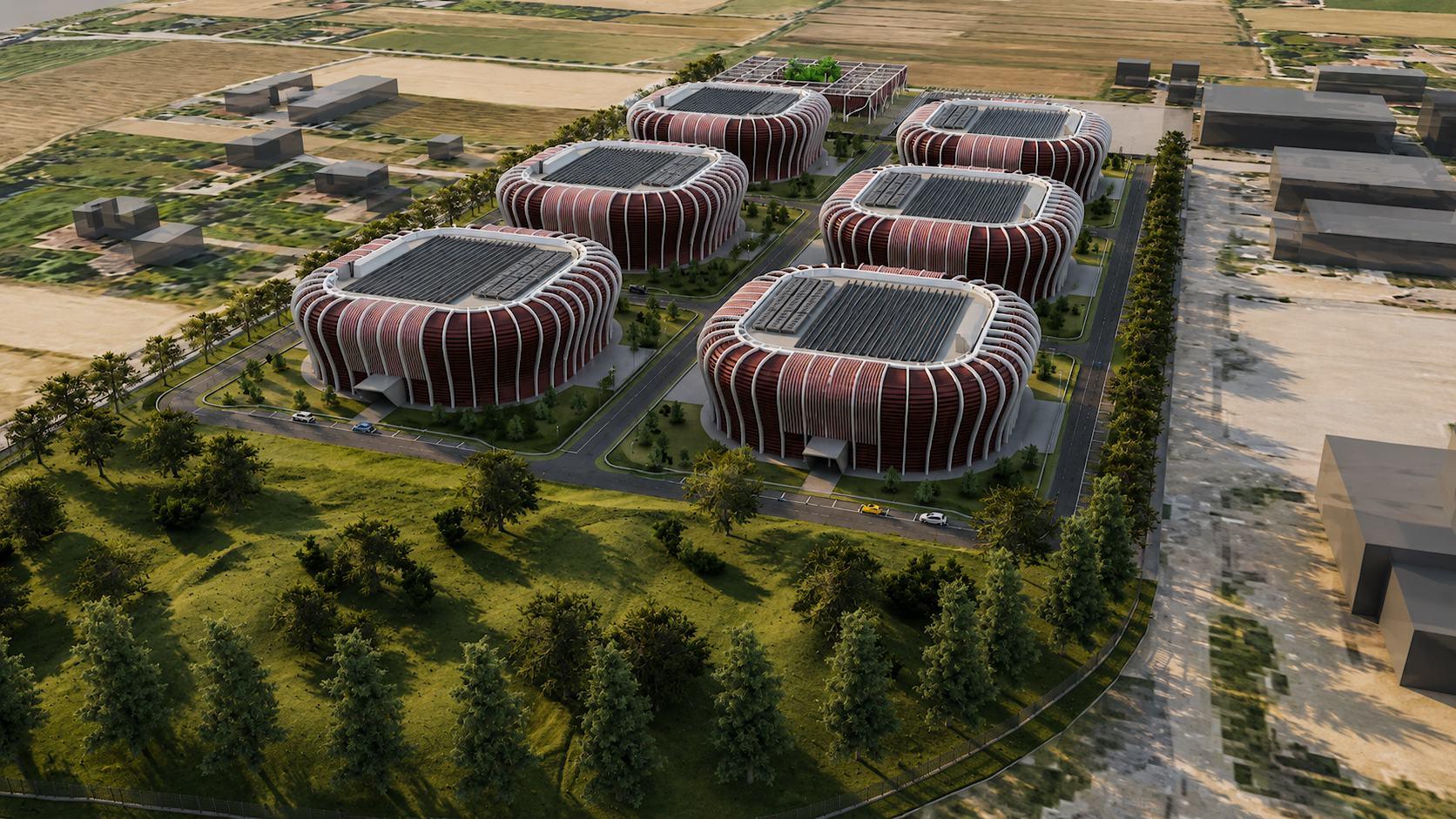


Data Centers represent the most emblematic technological infrastructure of our era, and their deployment is steadily growing with increasing digitalization.
Our holistic approach to design addresses a range of complexities, taking into account contextual needs such as environmental sustainability and community requirements, as well as needs specific to the facility, such as physical and cybersecurity systems. This intertwining of requirements—technological efficiency, sustainability, and security—demands an architectural conception that goes beyond mere building appearance.
Although they are imposing and functional structures, we believe it is essential that Data Centers do not present themselves as standardized industrial buildings, detached from the surrounding landscape. For this reason, we pay particular attention to architectural design, directing it toward reducing visual impact and integrating the building into its environmental context.
Our commitment to innovative and iconic design translates into the use of cutting-edge forms and materials.
Interdisciplinary approach, sensitivity, and respect for the “human dimension” are an integral part of our philosophy.
Every detail is designed with the utmost care, paying particular attention to the use of eco-friendly materials and innovative solutions, alongside building automation and IT systems for building management. This perspective allows us to create spaces that are not only aesthetically distinctive but also environmentally responsible.
Every aspect of the project is carefully handled, from the concept phase through to final realization, also addressing particularly complex design issues with effective solutions.
Our editorial output highlights the particular attention we have always devoted to cultural research, with the aim of disseminating in-depth studies on architecture and on specific architects through articles, essays, and publications.
The restoration of the Church of Santa Maria Assunta in Santomato – 2003;
Restorations at the Parish Church of San Matteo in San Mommè – 2004;
The restoration of the Tabernacle of Candeglia – 2009;
The Madonna dei Minelli in Capostrada – 2009;
Safeguarding 20th-century heritage – 2013;
Itineraries of Italian architecture of the 20th century – 2015;
Communicating transformation – 2015;
Architecture and Path, Florence, Edifir edizioni, 2016;
Architecture for culture – 2017;
Raffaello Franci, Franciscan architect – 2018;
The figure and work of Leonardo Ricci on the centenary of his birth – 2020;
Architecture and nomadism – 2022.
This work is complemented by the work Paolo Caggiano carries out as curator of 3gA, a Pistoia cultural event of which he is a co-founder.
PC Studio Architettura, founded by Paolo Caggiano, specializes in interior design and architectural design for civil construction and high-technology facilities (data centers).
Architectural space is at the heart of the studio’s activities. This implies profound attention not only to building design but above all to the creation of environments that foster social interaction and well-being. Architecture is thus understood as a means of improving quality of life, placing the needs and dynamics of the community first.
PC Studio Architettura’s activities extend across all phases of the construction process, ensuring an integrated approach that ranges from initial design through to the final realization of the work. Thanks to long-established consultancy relationships and collaborations, the studio is able to provide effective solutions even for complex design issues.
Contact us HERE!
Meet the studio
The staff is made up of members with diverse backgrounds and skills, each of whom brings unique value to the group. This interdisciplinarity makes it possible to build a resilient and flexible team, capable of tackling and adapting to different projects, whether complex or innovative. Thanks to the variety of experiences and knowledge, the team is able to address challenges creatively and collaboratively, finding tailored solutions for every situation. In this way, we are ready to respond to our clients’ constantly evolving needs and to ensure high-quality results.
Founder Paolo Caggiano is a member of the Steering Committee of the International Centre for the Conservation of Architectural Heritage, a private non-governmental organization working in the field of safeguarding and enhancing architectural heritage, for which he organizes seminars and advanced training courses. He is also engaged in professional issues, holding various institutional roles in professional bodies.
Paolo Caggiano
Architetto
Founder of the studio
1995 – Laurea Magistrale in Architettura presso l’Università degli Studi di Firenze – Facoltà di Architettura
Daniele Calugi
Architetto
2002 – Laurea Magistrale in Architettura presso l’Università degli Studi di Firenze – Facoltà di Architettura
Michelle Lee Freeborn
Designer
1990 – Laurea in Storia dell’Arte presso l’Università degli San Francisco – California (U.S.A.)
1992 – Master post laurea in Design presso Palazzo Spinelli, Firenze
Serena Zarrini
Architetto
1999 – Laurea Magistrale in Architettura presso l’Università degli Studi di Firenze – Facoltà di Architettura
Riccardo Masala
Architetto
2011 – Laurea Magistrale in Architettura presso l’Università degli Studi di Firenze – Facoltà di Architettura
Nicola Baldinelli
Geometra
1997 – Diplomato presso l’Istituto Fermi di Pistoia